> For the complete documentation index, see [llms.txt](https://docs.tryprotege.com/llms.txt). Markdown versions of documentation pages are available by appending `.md` to page URLs; this page is available as [Markdown](https://docs.tryprotege.com/review/review-tool-concepts/brands-and-attributes/use-in-content-scanning-job.md).
# Use in Content Scanning Job
### 📝 Using Brands and Attributes in Content Scanner Jobs
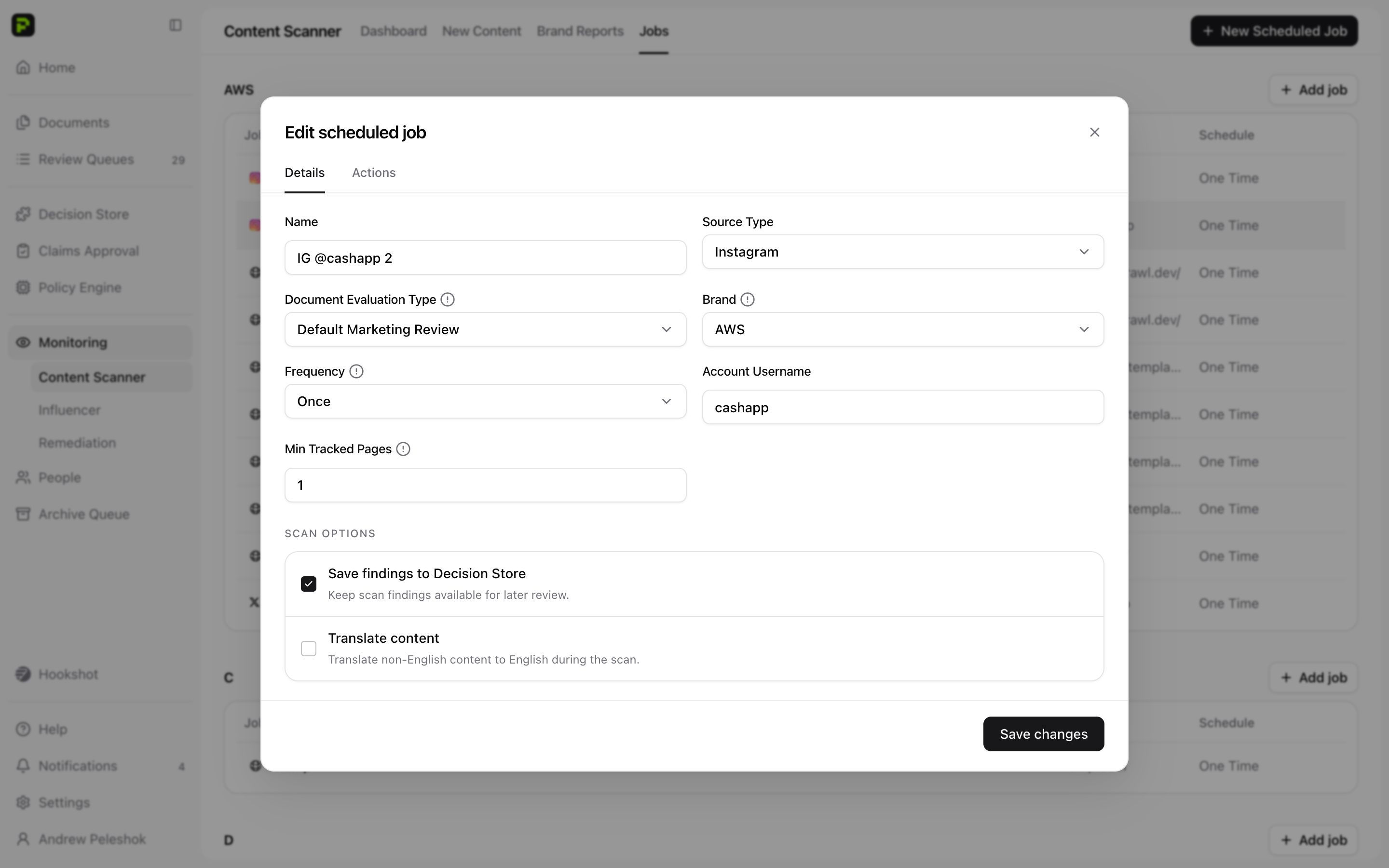
When creating a new Content Scanner Job, you can assign a Brand and one or more Attributes to tailor the policy execution to the context of the content being scanned.
#### ✅ How It Works:
* Brand Selection
The Brand is chosen from a dedicated section in the job setup form. This defines the overarching identity (e.g., product line, business unit) that the content belongs to.
* Attributes Assignment
In the Attributes section, you define key context elements by selecting Field–Value pairs.
For example:
* Channel = SocialMedia
* Region = US
* ProductCategory = Serum
These inputs influence how Protege Review determines which Policies to apply during the scan.
#### 🎯 Why It Matters:
Protege Review uses the assigned Brand and Attributes to:
* Dynamically select and execute the appropriate policies.
* Ensure regulatory rules are matched to the correct context.
* Improve precision and reduce unnecessary alerts.
This makes every scan more accurate and context-aware — especially useful for content spanning multiple markets, products, or audience types.
---
# Agent Instructions
This documentation is published with GitBook. GitBook is the documentation platform designed so that both humans and AI agents can read, navigate, and reason over technical content effectively. Learn more at gitbook.com.
## Querying This Documentation
If you need additional information that is not directly available in this page, you can query the documentation dynamically by asking a question.
Perform an HTTP GET request on the current page URL with the `ask` query parameter, and the optional `goal` query parameter:
```
GET https://docs.tryprotege.com/review/review-tool-concepts/brands-and-attributes/use-in-content-scanning-job.md?ask=&goal=
```
`ask` is the immediate question: it should be specific, self-contained, and written in natural language.
`goal` is optional and describes the broader end goal you are ultimately trying to accomplish on behalf of the user. GitBook uses it to tailor the answer towards what is most useful for that goal.
The response will contain a direct answer to the question and relevant excerpts and sources from the documentation.
Use this mechanism when the answer is not explicitly present in the current page, you need clarification or additional context, or you want to retrieve related documentation sections.